
Thresholds and ordeals
The ordeals of the path
Why does the path put us to the test? Maestro Cornelio teaches that ordeals are not punishments but revelations: they show where one truly stands, like the labyrinth that always leads back towards the centre.
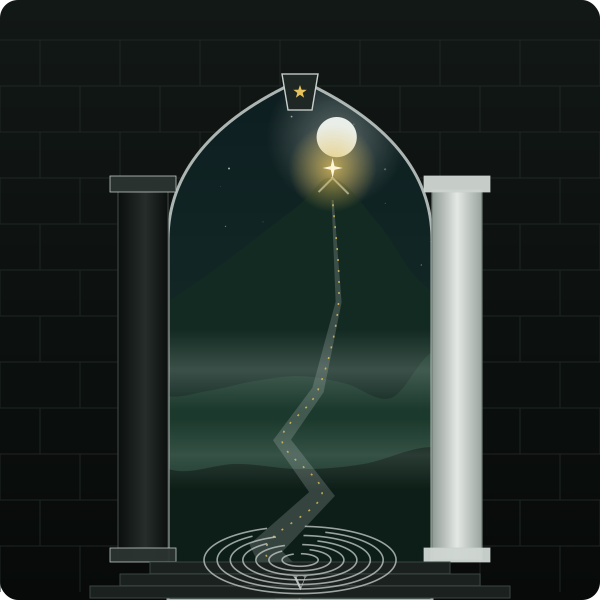
Those who begin the path often hope for a road that climbs but stays serene, made of steady progress. They soon discover it is not so. Difficulties arrive, doubts, falls, sometimes just when one felt furthest along. Maestro Cornelio teaches us to give these moments their traditional name: the ordeals. And he teaches us not to fear them.
Revelations, not punishments
The first thing the Master makes clear is that ordeals are not punishments. No one inflicts them in order to chastise. They are rather revelations: they show where one truly stands, beyond what one believes oneself to be. Whoever thought they had conquered fear finds it again before a new situation; whoever thought they were patient discovers their limit. The ordeal takes nothing away: it reveals what was already there, and so makes it possible to work on it.
The labyrinth
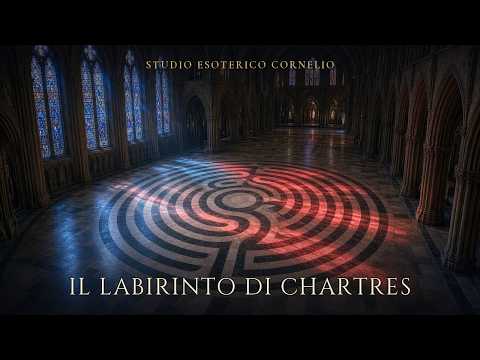
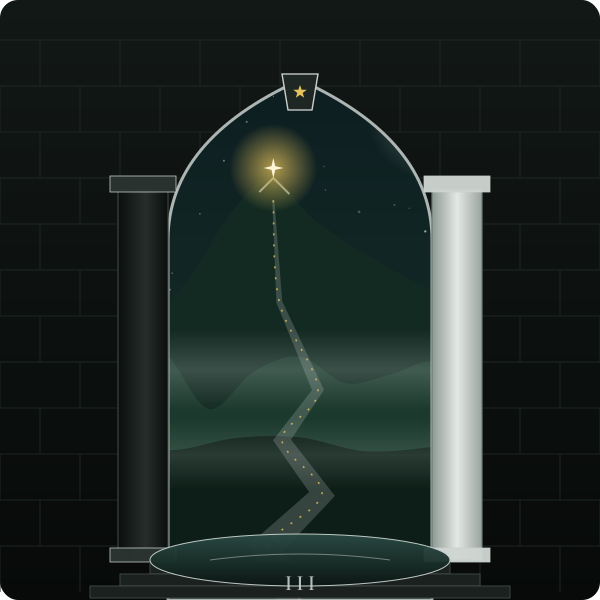
The image accompanying this entry is a labyrinth traced in front of the steps of the threshold. The Master chooses the classical labyrinth, the single-path kind seen on cathedral floors such as Chartres: not a maze with dead ends in which to get lost, but a single trail that winds back on itself. One advances towards the centre and then, suddenly, the path moves away from it; one returns almost to the outside, and then draws near again. Whoever walks it often has the impression of going backwards. And yet every step leads to the centre.
In the labyrinth one does not get lost: one is led to the centre by the longest way.
Going backwards
This is the most precious lesson. On the inner path ordeals often give the impression of regressing: one returns to old fears, old habits, moods one thought were behind one. The Master teaches that this is not a return to the starting point, but a passage along a ring closer to the centre. One goes over the same theme again, but from a different distance. Whoever understands this stops despairing at every fall.
The four ordeals
Tradition has often described the initiate's ordeals through the four elements: the ordeals of earth, fire, water and air. The Master translates them into inner terms. The ordeal of earth is boredom, the effort of constancy when practice no longer gives pleasure. The ordeal of water is the emotions, which overwhelm and confuse. The ordeal of fire is desire, which pushes one to stray from one's road towards whatever shines brightest. The ordeal of air is doubt, the mind that dismantles everything one has built. Each is overcome with the opposite element: constancy with joy, emotions with clarity, desire with measure, doubt with experience recorded in the journal.
Do not seek ordeals
The Master warns against a common mistake: seeking out ordeals, inventing difficulties to prove one's strength. True ordeals arrive by themselves, in everyday life, without any need to provoke them. Whoever seeks them turns the path into a heroic spectacle; whoever welcomes them when they come turns the path into a life. The second road is humbler, and safer.
At the centre
What lies at the centre of the labyrinth? Traditions have answered in many ways: the Minotaur to be defeated, the heavenly Jerusalem, the rose. The Master answers with the Law: at the centre is one's own star, the point one set out from without knowing it. Ordeals serve to lead back there, removing layer after layer of what was hiding it. This is why, the Master teaches, at the end of every ordeal one can say thank you: not to the pain, but to the truth it revealed.
Watch the video
Read next
What initiation is: entering into oneself
For Maestro Cornelio, being initiated does not mean joining an organisation or receiving a title, but beginning the path towards one's own centre, where one's true Will dwells.
The threshold and the oath
To cross a threshold is to decide. Maestro Cornelio teaches that the initiate's oath counts for what one does, not for what one says, and that the veil lifts a little at a time.
"Know thyself": the initiate's mirror
The words carved on the temple at Delphi as the first commandment of the path: Maestro Cornelio explains why self-knowledge is both the starting point and the goal.
