
The Abyss and the heights
The Abyss: beyond the dividing mind
The hardest passage on the path: leaving the mind that divides and judges to enter the consciousness that unites. Maestro Cornelio explains the Abyss without drama and without fear.
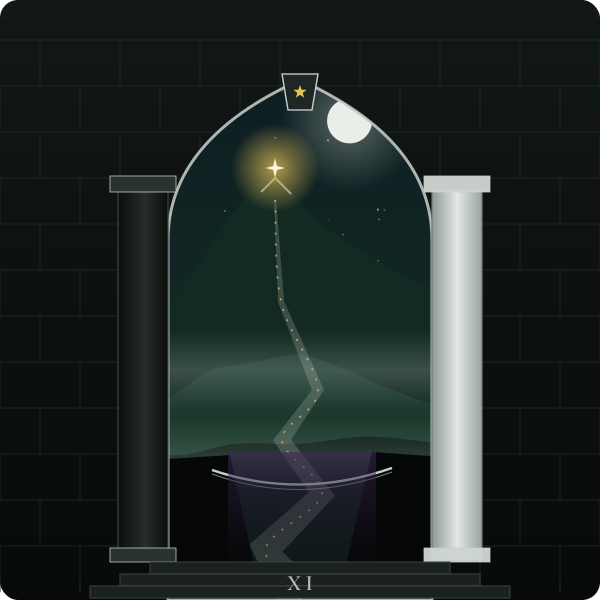
On the path Maestro Cornelio teaches there is a point that tradition has always described with dread: the Abyss. It is the passage in which everything one has built with the mind must be let go, so that consciousness can become whole. The Master speaks of it without drama, but seriously: it is the hardest passage, and also the most liberating.
The dividing mind
To understand the Abyss one must understand what is left behind. The Master describes the ordinary mind as a mind that divides: it distinguishes, classifies, judges, opposes. It is a marvellous tool, without which we could not live in the world; but it has a limit. It always sees things as separate: I and others, good and evil, before and after. The more one relies on it alone, the more the world appears as a collection of fragments in conflict.
The uniting consciousness
Beyond the dividing mind, the Master teaches, there is a consciousness that unites. It does not erase distinctions, but sees them from above, as parts of a single reality. It is the consciousness the Law points to with the image of a star in the infinite sky: a point that contains the whole universe. Mystics of every tradition have described it in different words; the philosopher Plotinus called it the return to the One, "the flight of the alone to the Alone".
Beyond the Abyss nothing of what you are is lost: only the fear of not being it.
The passage
Why an abyss? Because there is no comfortable bridge between the two kinds of consciousness. To pass from one to the other one must give up, at least for a moment, the securities of the mind: one's opinions, one's identities, even one's idea of the path. This is what frightens. The mind fears dissolving, and clings to everything it knows. The Master teaches that the Abyss is crossed only by letting go.
The danger of dispersion
Tradition warns of a risk: whoever approaches the Abyss without being rooted in their own Will can be lost in dispersion. Without a centre, the dismantling of certainties becomes confusion, anguish, bewilderment. This is why the Master places the Abyss after the meeting with the Angel: only those who know their orbit can afford to let go of everything else without getting lost. Discipline, the journal, concentration are not superfluous preliminaries, but the rope that holds one on the edge.
The thin bridge
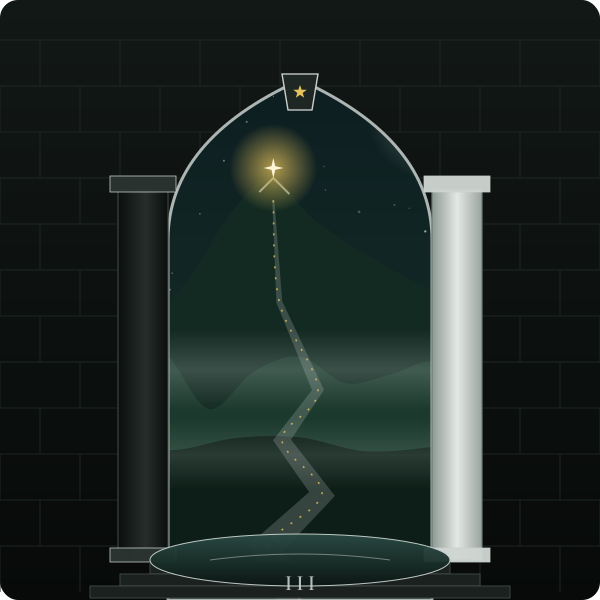
The image accompanying this entry shows a dark rift cutting across the path, spanned by a very thin bridge. The Master uses it to say that the Abyss is not leapt in a heroic bound but crossed one step after another, on a thread of trust. One does not look down: one looks at the light beyond the mountain. One carries nothing: the hands must be free to keep one's balance.
Everyday abysses
The Master teaches that the Abyss, in its full form, is a rare passage of the inner life. But it has everyday reflections: every time we must give up an opinion we were attached to, every time a built identity cracks, every time we must accept not knowing. In those moments one feels a small vertigo. The Master suggests welcoming it without fleeing, breathing calmly: it is a miniature exercise for the greater passage.
Beyond
What lies beyond the Abyss? The Master answers with one of the shortest sayings gathered by the Studio: "There is nothing else." Not a new system of ideas, not a secret doctrine, but the simplicity of a consciousness that no longer needs to divide in order to understand. Whoever has crossed the Abyss returns to the world and goes on using the mind, but is no longer its prisoner. It is the fulfilment of the Great Work: the stone that no longer fears dissolution, because it has already passed through it.
Watch the video
Read next
What initiation is: entering into oneself
For Maestro Cornelio, being initiated does not mean joining an organisation or receiving a title, but beginning the path towards one's own centre, where one's true Will dwells.
The threshold and the oath
To cross a threshold is to decide. Maestro Cornelio teaches that the initiate's oath counts for what one does, not for what one says, and that the veil lifts a little at a time.
"Know thyself": the initiate's mirror
The words carved on the temple at Delphi as the first commandment of the path: Maestro Cornelio explains why self-knowledge is both the starting point and the goal.
